Building AI Applications Without Code: A Practical Guide to No-Code Development Tools
The Evolution of AI Development Tools
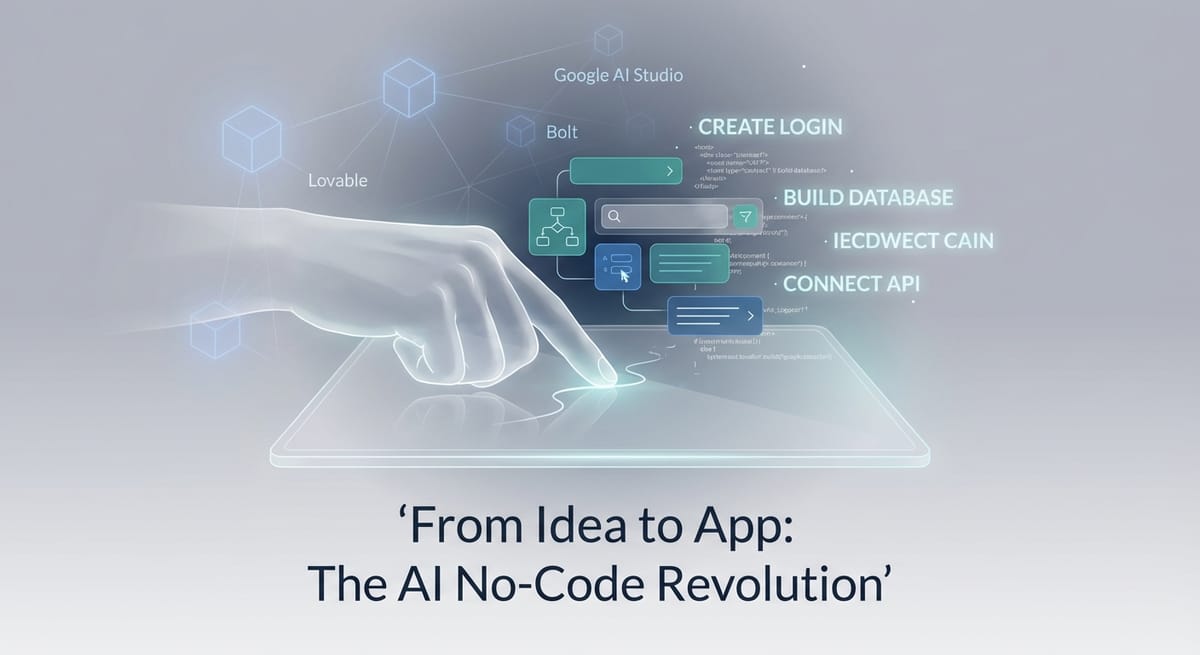
The landscape of application development has changed dramatically in recent months. What once required extensive coding knowledge and months of development time can now be accomplished in hours through AI-powered no-code platforms. Tools like Lovable, Bolt, and Google AI Studio are democratizing software development, allowing anyone with an idea to bring it to life through simple prompting.
These platforms represent a fundamental shift in how we approach building digital solutions. Instead of writing code line by line, developers and non-developers alike can describe what they want in plain language, and AI handles the technical implementation. The result is a dramatically shortened path from concept to working prototype.
Key Platforms for No-Code AI Development
Several platforms have emerged as leaders in the no-code development space. Lovable stands out for its integrated approach, offering not just frontend development but also backend functionality including database management and user authentication. The platform provides its own hosting solution, making it possible to go from idea to published application without ever leaving the environment.
Google AI Studio takes a different approach, offering deep integration with Google's ecosystem of services and APIs. While it may not have all the backend capabilities of Lovable yet, it excels at creating interactive experiences and has particularly strong capabilities for building games and 3D interfaces. The platform benefits from Google's prolific development cycle, with new features and improvements released almost daily.
Bolt offers similar capabilities to Lovable, with its own strengths in rapid prototyping and deployment. Like the others, it allows users to start with simple prompts and iteratively refine their applications through conversation.
The Development Process
Working with these tools follows an iterative pattern. You start with a basic prompt describing what you want to build. The AI generates an initial version, which you can then refine through additional prompts. For example, you might start by asking for a furniture design tool, then add features like parts lists, blueprints, and assembly instructions through follow-up prompts.
The process is conversational and forgiving. If something does not work as expected, you can simply describe the problem or ask the AI to fix errors. Many platforms now include suggestion features that anticipate what you might want to add next based on the context of what you are building.
One important consideration is knowing when to graduate from these no-code platforms to more advanced development environments. Tools like Cursor, Windsurf, and Google's Anti-Gravity allow you to export your code and continue development with greater control over complex logic and functionality. This hybrid approach combines the speed of no-code prototyping with the power of traditional development when needed.
Practical Applications and Real-World Use Cases
The applications for these tools extend far beyond simple websites. Organizations are using them to build internal tools, customer-facing applications, and workflow automation solutions. A furniture company could create a customer-facing design tool that generates not just visualizations but complete manufacturing specifications. A nonprofit could build a custom donor management interface tailored to their specific needs.
The integration capabilities are particularly powerful. These platforms can connect to email services, CRM systems, payment processors, and countless other third-party services through APIs. This means your no-code application can interact with your existing technology stack without requiring custom integration work.
Security and Enterprise Considerations
While these platforms make development accessible, they are still evolving in terms of enterprise-grade security, scalability, and compliance features. Current implementations may not yet meet the requirements for applications handling sensitive data or serving thousands of concurrent users. However, the pace of improvement is rapid, and these limitations are being addressed with each new generation of tools.
Organizations should carefully review security practices, particularly around API key management and data protection. Some platforms handle these concerns better than others, and in some cases, exporting code to a more controlled environment may be necessary to meet security requirements.
Cost Considerations and Getting Started
Most no-code platforms operate on subscription models, typically ranging from free tiers for experimentation to $20-30 per month for more serious use. Additional costs may come from hosting, custom domains, and integrations with third-party services. The good news is that you can start experimenting at little to no cost, making it easy to explore capabilities before committing to paid plans.
For organizations just beginning their journey with these tools, the best approach is to start small. Identify a specific problem or use case, then use it as a learning opportunity. Build a simple internal tool or a landing page. The iterative nature of these platforms means you can start basic and add sophistication over time as your understanding grows.
The Future of Development
We are in the early chapters of a fundamental transformation in how software gets built. The combination of AI-powered development tools, workflow automation platforms, and agent-based systems is creating an ecosystem where the bottleneck is increasingly about knowing what to build rather than how to build it. The technical barrier to entry is dropping rapidly, making software development accessible to a much broader audience.
This democratization does not eliminate the need for technical expertise. Software developers still play a crucial role in architecting complex systems, ensuring security, and optimizing performance. However, the nature of development work is shifting toward higher-level problem solving and away from routine coding tasks.
For individuals and organizations willing to invest time in learning these new tools, the opportunity is significant. The ability to rapidly prototype, test, and deploy solutions creates a competitive advantage in an increasingly digital world. The key is to start experimenting, accept that there will be a learning curve, and recognize that these tools are enablers of creativity and problem-solving rather than complete solutions in themselves.