Empowering Middle Managers in Your AI Journey
Why Middle Managers Are Essential AI Change Champions in Your Organization
Middle managers play a crucial role in your company's success with artificial intelligence (AI). Positioned between executive strategy and day-to-day operations, they act as vital change champions in your AI journey. They translate high-level AI visions into practical actions that teams can execute.
AI can be intimidating for many employees. Some worry about job security, while others don’t understand its benefits or limits. Middle managers face these concerns daily and need the right tools and authority to address them effectively.
Consider your organization today. Do your middle managers know which AI tools employees are using? Can they clearly communicate what is allowed and what isn’t? Do they have guidelines to share? If you answered no, you are not alone. Many small and mid-sized organizations are navigating these same challenges.
Empower Middle Managers with Clear Decision Rights Using a Simple Approval System
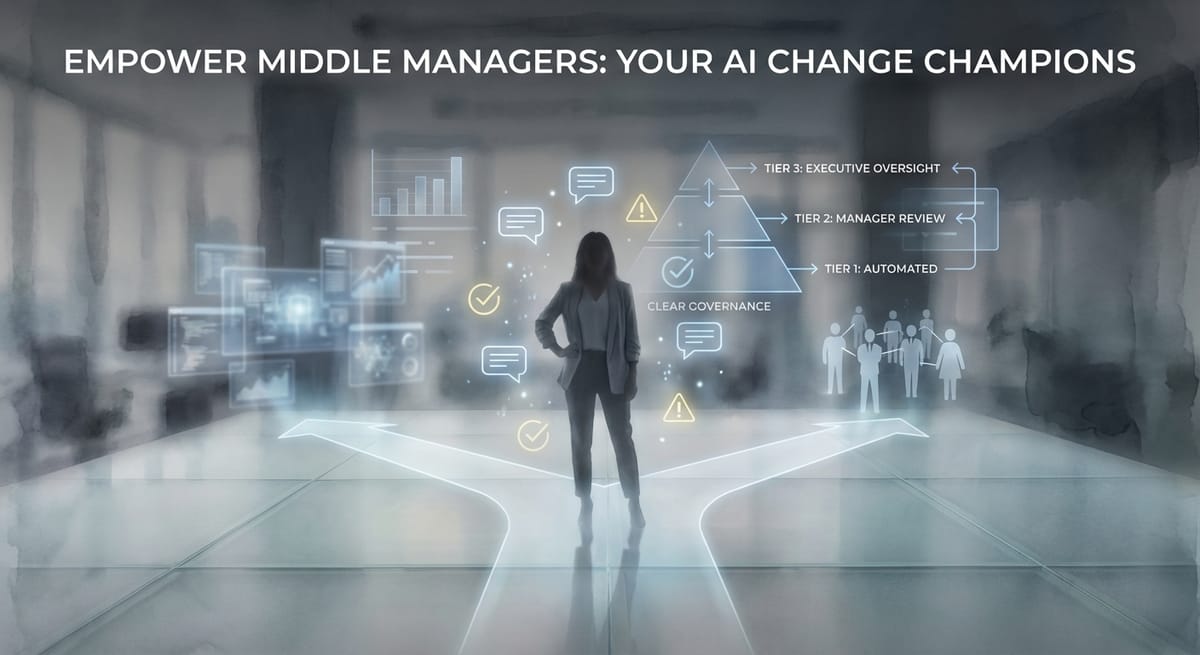
Middle managers need clear boundaries on when they can approve AI use and when they should escalate issues. A straightforward three-tier approval system can help.
Tier One requires no approval. These are low-risk uses with established tools. For example, using ChatGPT to brainstorm ideas, Grammarly for editing, or AI to summarize internal documents. Managers can encourage these freely.
Tier Two needs manager approval. This covers new AI use cases with existing tools or applications with some uncertainty. For example, using AI for customer communications or analyzing new types of data. Managers review these situations and make decisions.
Tier Three requires leadership approval. High-risk decisions such as purchasing new AI software, using AI for hiring decisions, or processing sensitive customer data require executive review.
This system removes guesswork. Middle managers know their limits, and employees know whom to ask. This clarity speeds up decision-making.
Provide Clear AI Governance Guidelines That Middle Managers Can Communicate
Clear, concise rules matter more than lengthy policies. Middle managers need simple guidance on what employees can and cannot do with AI.
Start with prohibited uses. For example, no proprietary information should be shared with unprotected chatbots, customer data should not be used without approval, and final hiring or firing decisions cannot be made by AI alone. Keep this list focused on high-risk areas.
Next, define permitted uses. Writing first drafts of documents, generating marketing ideas, summarizing long reports, and creating meeting notes are all acceptable. Provide specific examples tied to your business context.
Middle managers become the first point of contact for employee questions. For instance, if an employee asks, “Can I use AI to write this client email?” the manager can respond confidently because they have clear categories to guide their answer.
Build Middle Managers’ Confidence Through Hands-On AI Training
Give middle managers direct experience with AI tools instead of just handing them policy documents. Show them what good AI use looks like.
Set up practical sessions where managers use AI to solve real problems in their departments. Let them see AI summarize emails, plan schedules, or analyze data firsthand. When they understand AI’s value, they can better teach their teams.
Address their concerns openly. Discuss potential misuse, how to spot AI hallucinations, and when bias might be an issue. Provide concrete examples and clear answers.
Establish a feedback process. Middle managers will discover new use cases and potential problems. They need a way to report this back to leadership. Schedule regular check-ins to discuss successes and challenges.
Train Middle Managers to Assess AI Risks Effectively
Equip managers with a simple mental framework to evaluate AI requests based on likelihood and impact.
High likelihood and high impact risks require immediate attention. For example, someone submitting customer data to an unprotected tool should be stopped and redirected.
High likelihood and low impact issues, such as AI hallucinating during brainstorming, can be managed by coaching employees on better prompting.
Low likelihood and high impact risks like data breaches need planning. Managers should know the incident response steps and contacts.
Low likelihood and low impact concerns can usually be ignored to avoid wasting resources on improbable problems.
This framework helps middle managers make timely, informed decisions and know when to escalate.
Provide Practical Documentation Tailored to Middle Managers’ Needs
Middle managers benefit from concise reference materials rather than long policy manuals. Offer a simple guide of one to three pages.
Include the three-tier approval system, lists of prohibited and permitted uses, business-specific examples, and contact information for escalation.
Create quick job aids for common situations, such as a flowchart for evaluating new AI tools or a checklist for reviewing AI-generated content. Brief guides work better than lengthy documents.
Regularly update these materials. AI changes rapidly, so review and revise the documents at least quarterly with middle managers’ input.
Empower Middle Managers to Coach Employees and Foster AI Champions
In smaller organizations, middle managers can have meaningful conversations about AI use and coach their teams in real time.
If an employee uses AI incorrectly, managers should ask why. This often reveals a training gap or a process issue. Maybe the employee lacked confidence in their task, seeing AI as a shortcut. This becomes an opportunity for development rather than just a policy violation.
Encourage managers to share success stories. Recognizing and spreading examples of clever AI use builds momentum and shares best practices across teams.
Give managers the authority to approve small AI experiments within clear limits. These pilots help teams learn safely without exposing the organization to major risks.
Track Progress and Use Feedback for Continuous Improvement
Set up simple tracking systems. Middle managers can log new AI tool requests, unusual uses, and issues. This could be a shared spreadsheet or similar tool.
Review these logs regularly—monthly or quarterly. Identify trends, such as multiple requests for the same AI capability, indicating a need for new tools or training updates.
Use this feedback to improve policies and training. The goal is continuous adaptation, not perfection. Middle managers act as sensors, providing ground-level insights to improve your AI strategy.
Start Small and Expand Middle Manager Empowerment Gradually
Begin with one or two middle managers. Give them the framework, tools, and support. Let them work with their teams for a month and learn from their experience.
Then gradually expand to more managers. Share lessons learned and refine your approach to build confidence over time.
Remember, middle managers themselves are managing change. They may have concerns about AI that must be addressed first. A manager who understands and supports AI is far more effective in guiding their team.
Your AI success depends on middle managers. Strategy at the top means little without practical action on the ground. Empower them with clear authority, useful tools, and ongoing support. They become your multiplier, turning AI potential into real business results.
Conclusion: Empower Middle Managers to Lead Your AI Success
Middle managers are linchpins in turning AI strategies into successful execution. Providing them with clear decision rights, practical governance, training, and documentation equips them to be effective change champions. These empowered managers bridge the gap between strategy and operations and help create a culture of responsible AI use. Invest in your middle managers today and watch your organization thrive in the age of AI.