
How to Embed AI into Your Annual Business Planning Process
Why AI Business Planning Should Be Part of Your Annual Strategy
Many organizations mistakenly view AI as merely a technology project. They hand it off to IT, wait for a report, and then move on. However, AI business planning is much more strategic. It belongs in your annual strategy process alongside headcount, capital expenditure, and revenue goals. If you are a planning, finance, or strategy director, integrating AI into your planning cycle is essential in today’s competitive market.
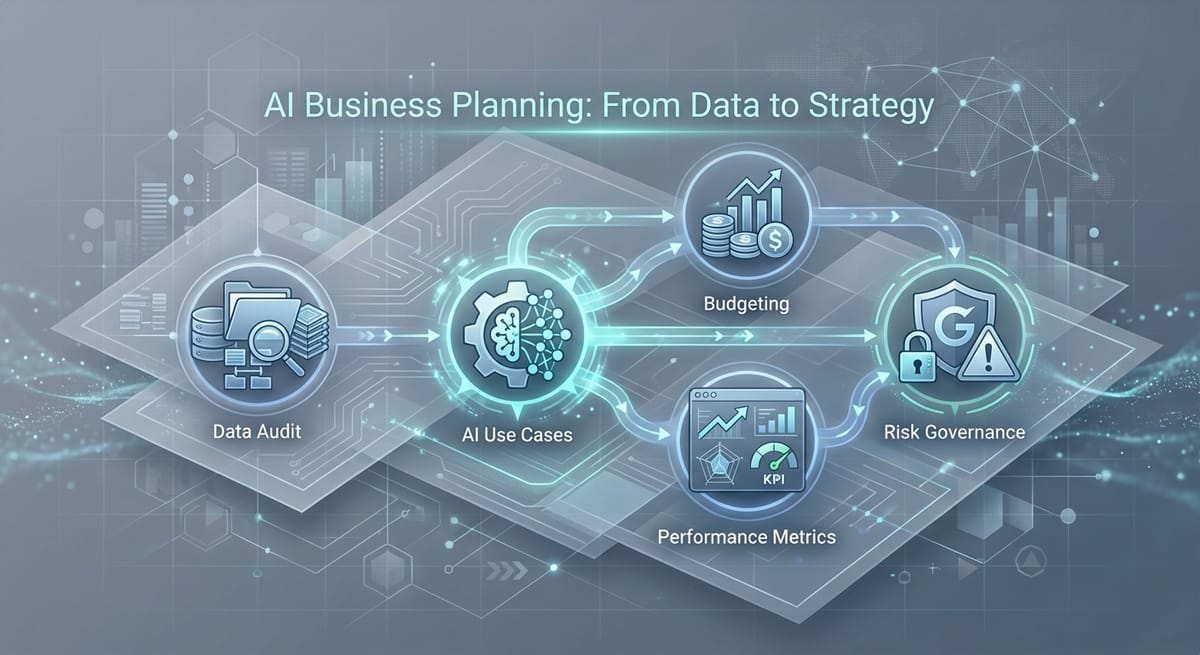
This article provides a clear, step-by-step framework to incorporate AI opportunities, risks, and performance metrics into your yearly planning, budgeting, and goal-setting efforts.
Step 1: Audit Your Data to Confirm Readiness Before Planning
The success of any AI initiative depends on the quality and readiness of your data. As one instructor put it: "Garbage in, garbage out." Before allocating any budget to AI business planning, you need a detailed, factual inventory of your data assets.
Conduct a data readiness audit across four key areas:
- Quality: Is your data accurate, consistent, complete, and current? Issues like mixed date formats, duplicate records, and missing fields will reduce AI output quality.
- Accessibility: Can the right stakeholders access the data they need? Data silos and gatekeepers in departments can block planning and execution.
- Ownership and Rights: Who owns each dataset? What privacy, legal, or regulatory requirements apply, such as HIPAA or GDPR? These affect how data can be used with AI tools.
- Infrastructure: Where is your data stored: cloud, on-premises, or hybrid? Are systems integrated via APIs, or is data entered manually in multiple places?
Weakness in any of these areas undermines the rest. Complete this data readiness audit before your planning cycle starts—not after your budget is set.
Step 2: Align AI Use Cases with Your Strategic Annual Goals
Your annual strategy begins by setting clear business priorities. AI use cases should fit directly into these priorities, not exist as separate projects.
For each strategic goal, ask yourself:
- Is there a decision or task related to this goal that takes too long or produces inconsistent results?
- Do we have clean, accessible data to support an AI tool for this goal?
- Can we measure if AI improves outcomes in this area?
Limit your choices to two or three actionable AI use cases each planning cycle. Trying to do too many often weakens efforts and leads to poor results. Focus where data readiness and business impact overlap.
Step 3: Budgeting for AI - Plan for All Costs
Successful AI business planning requires realistic budgeting. AI costs are often underestimated. Plan your budget across three main categories:
- Licensing and Subscriptions: Paid AI tools like Claude, ChatGPT, or Gemini require licensing fees. Free accounts may use your data for model training, raising legal and privacy concerns.
- Data Preparation: Around 80% of project time goes to cleaning and formatting data before AI modeling begins. Allocate sufficient staff hours for this essential step.
- Ongoing Maintenance: Maintaining each data field can cost about $1,500 annually. Plan for these recurring costs to avoid surprises.
Step 4: Include Measurable AI Performance Metrics in Your Planning
Without measurable metrics, AI investments become faith-based. Tie each AI use case to at least one leading and one lagging indicator.
Lagging indicators show results after the fact, such as cost per lead, time to complete reports, or employee hours saved each month. Leading indicators indicate progress and might include data completeness, prompt accuracy, or the number of validated AI outputs weekly.
The real value of AI is discovering patterns invisible to traditional reports. To make the most of this, define meaningful patterns and success criteria in advance as part of your goal integration.
Step 5: Address AI Risks and Set Governance Rules in Your Planning
Annual strategy and business planning is where you price and manage organizational risks. AI introduces unique risks that must be managed explicitly:
- Hallucination: AI can generate confident but incorrect results. All AI outputs that affect financial or strategic decisions require strict human validation.
- Data Training Risks: Many AI platforms use your inputs to train their models by default unless you opt out, which poses legal and policy risks.
- Cutoff Dates: Large language models have fixed training data cutoff dates. For up-to-date market or event data, use tools with real-time access, like Perplexity or Google's AI Mode.
- Access Creep: Uncontrolled staff access to AI connected to internal data increases audit risks, especially during security reviews such as SOC 2.
Your AI governance rules should be part of your data governance policies to create a unified risk management approach.
Step 6: Set Quarterly Reviews for Continuous Improvement
AI models and data quality change over time. Include quarterly reviews in your business planning to check:
- Are AI outputs still accurate and reliable?
- Has the underlying data changed in ways that affect AI performance?
- Are performance metrics and goals still relevant, or has strategy shifted?
Effective AI business planning treats AI as a dynamic part of your operating model, not a one-time annual project.
Start with a Comprehensive Data Inventory for Effective AI Planning
The most important step before your next planning cycle is building a complete data inventory. Know what data you have, where it lives, who is responsible, and how clean it is. This inventory forms the base for every AI budget request, use case selection, and metric you define.
Without this foundation, you risk making AI investment decisions based on assumptions. Begin your AI business planning with facts instead.
Conclusion: Make AI a Strategic Part of Your Annual Business Planning
Embedding AI into your annual business planning process changes it from a separated technology project to a strategic asset. By focusing on data readiness, linking AI use cases to clear goals, budgeting realistically, managing risks carefully, and reviewing progress regularly, your organization can unlock AI’s full potential to deliver measurable business value. Start today by applying these best practices in your next budget cycle and lead your organization confidently into the future.